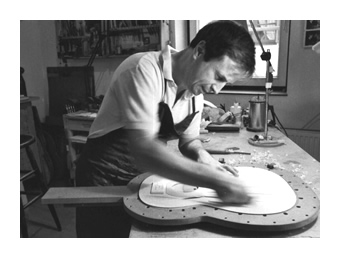
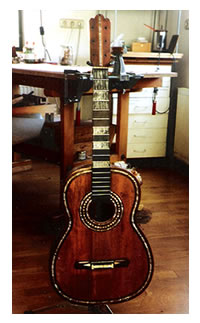
Before I comment on specific instruments in terms of their sound and historical significance, I would like to point out that I have only ever built instruments based on famous “original” instruments, particularly those made by distinguished Spanish Masters.
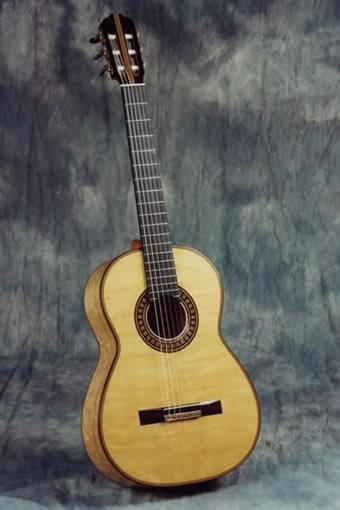 Fig. 2.1
| Model | Manuel Ramírez, 1912 |
|---|
| Woods | Bearclaw Spruce/Satin Wood |
|---|
The body of this guitar, compared to others I have researched, could be described as rather delicate, which belies the sheer volume and carrying power of the sound. This instrument has a fast response and produces a formable and transparent sound rich in tone colours.
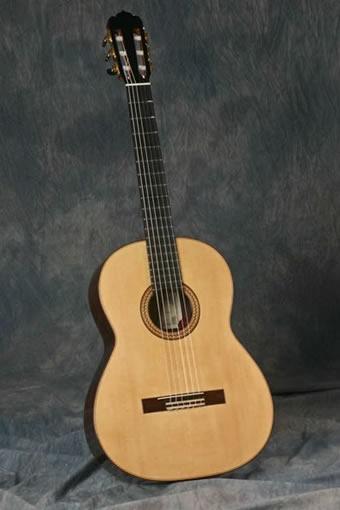 Fig. 2.2
| Model | Santos Hernández, 1924 |
|---|
| Woods | Spruce/Indian Rosewood |
|---|
This instrument was part of the estate of the late Luise Walker (1988). Her teacher, Miguel Llobet, personally brought this guitar direct from Santos Hernández’s workshop to Vienna in 1924. The body of this instrument is really the antithesis of the 1912 Ramirez in terms of its dimensions. The larger resonance body gives it somewhat more warmth to the sound in the bass.
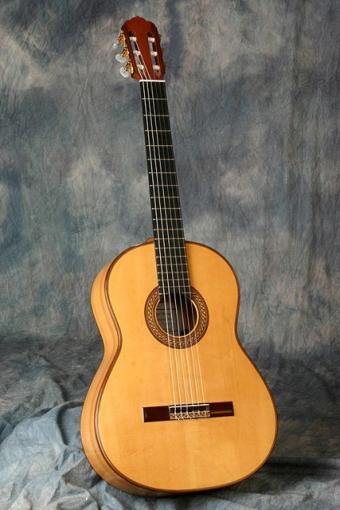 Fig. 2.3
| Model | Manuel Reyes, 1989 |
|---|
| Woods | Spruce/Cypress |
|---|
I use this design for flamenco guitars as well as for classical instruments with Cedar tops.
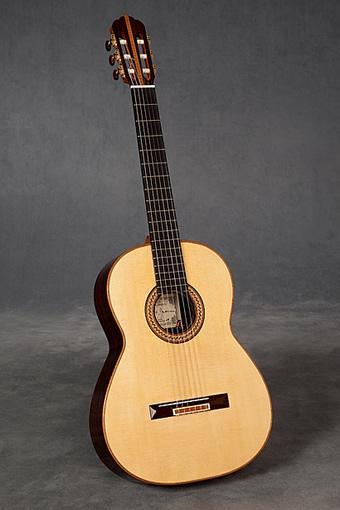 Fig. 2.4
| Model | Tobias Braun 2007 |
|---|
| Woods | Satinwood (West Indian - fagara flava) |
|---|
This is a stiff and heavy wood highly suitable for guitar bodies which Tobias has good experience of. At the same time it is very attractive particularly after it darkens with time, revealing more the characteristic figuring.
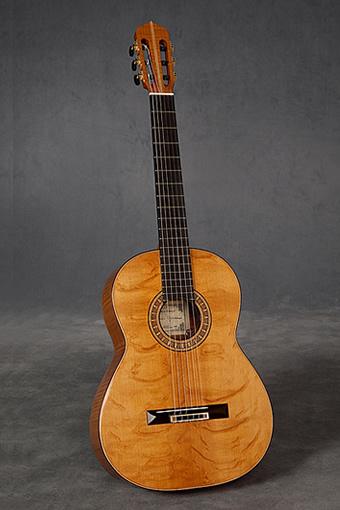 Fig. 2.5
| Model | Tobias Braun 2007 Thermowood |
|---|
| Woods | Thermowood |
|---|
Beautiful look and produces a formable and transparent sound, rich in tone colours.
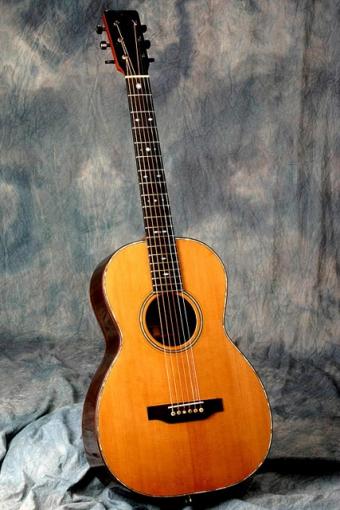 Fig. 2.6
| Model | Martin 00-21 |
|---|
| Woods | Sitka Spruce/Indian Rosewood |
|---|
The most fascinating about this instrument is its balanced sound. For a steel-string guitar, it has a really delicate body, but the basses and trebles are still very well balanced. Its transparency and the broader fingerboard make it ideally suited to finger-picking and bottle-neck players. The neck joins the body at the 12th fret – as it is with the original.
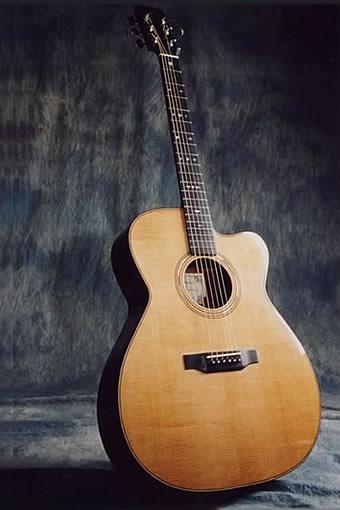 Fig. 2.7
| Model | Martin M-36 |
|---|
| Woods | Sitka Spruce/East Indian Rosewood |
|---|
This instrument too has a fast response and a well-balanced sound. It differs from the Martin 00-21 in that it boasts characteristics of a “standard” steel-string Guitar: larger body, narrow finger-board and the neck join at the 14th fret.
Sheet 04 →Special Models
„Collector´s series“ · Asymmetrical 10-string Guitar